Showing posts with label mobile technology. Show all posts

Thursday, December 03, 2009

Smartphones of the future


10 years ago, if you would have told someone that you could squeeze 16 GB of flash memory on something the size of a microSD card, people would have laughed. Think about the type of storage technology we had 10 years ago. In 1999, we were living in the era of Windows 98 (Windows XP was released in 2001). Did you have a PC running Windows 98? Do you even remember the specs on that PC? I had an analog Motorola StarTac cell phone in 1999. I remember paying quite a premium to have that phone.

If we could move forward 10 years, what will smartphones be like? I don't think anyone will debate that mobile phones will be capable of very high data transfer speeds. They will have very fast processors. They will come with a large amount of internal flash RAM. Hopefully they will have much better battery life.

I wonder if the majority of future smartphones will be designed with touch-screen navigation or buttons. Will we still have phones with a hardware QWERTY keyboard? Or, will everything be driven by voice recognition and touch navigation? It's a bit difficult to imagine, isn't it? 10 years can go by so quickly, yet so many technology advances can occur over 10 years.

Will we have flexible LCD displays? Will phones be thinner than they are today? Will they be capable of 3D holographic projections? Will everything be video phone calls?

As we prepare for 2010, I'm reminded of the type of technology I used in 1999. As we prepared for the Y2K bug 10 years ago, life seemed slower and simpler back then. Today, we have access to information everywhere and I'm always connected to the Web (thanks to my smartphone).

I'm saving some of my relics so that I can show them to my kids. I plan to build a little gadget museum in my house so they can appreciate how technology has changed over time.

Wednesday, April 15, 2009

Smartphone Use Increasing Among Physicians

According to a recent study by Manhattan Research, the use of smartphones among physicians is now at 64%. The study is titled, "Taking the Pulse v9.0." The use of mobile devices like the iPhone and BlackBerry increased by 20% in one year. It's not a surprise that the number of physicians who use the iPhone more than doubled in the past year. Now with the availability of the touch screen BlackBerry Storm, I anticipate that more doctors will be using the BlackBerry. Overall, physicians are spending more time online and are using both computers and smartphones to stay current and access medical information. They are also using mobile devices to access CME activities. So smartphones have a bright future ahead in the medical industry. As these devices become more powerful and ubiquitous, they will permeate the healthcare space and play an even larger role in the daily workflow of medical students, residents, physicians, nurses, and pharmacists.

I currently use a Windows Mobile device (the Verizon Wireless XV6800, also known as the Sprint Mogul and the HTC Titan). If I were on the AT&T network, I'd be an iPhone user. If I had to buy a new phone on Verizon, I'd probably get the new BlackBerry Storm that will have Wi-Fi. If I were on T-Mobile, I would get the G1 running Google Android.

Sunday, March 15, 2009

Mobile Phones and Public Health Implications


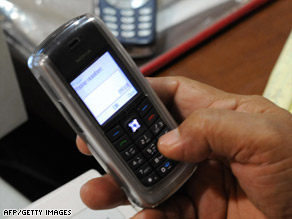
There's been a lot of controversy regarding the health effects of mobile phones. Recently, CNN reported about some of the potential public health implications of homes that only rely on mobile phones. My home is one of them. We don't have a landline phone. In fact, we haven't had a landline phone in years. I should sell my old landline phones on eBay.

Anyways, this article addresses the importance of epidemiological surveys conducted by the CDC and other organizations. These surveys are primarily conducted by phone, and only landline phone numbers get included in these studies. At 26 percent, Oklahoma has the highest percentage of homes that only have a mobile phone. Vermont has the lowest at only 5 percent. These are old statistics and most experts suspect that the numbers are considerably higher in 2009.

So if the CDC and other government agencies can't accurately track the health of the nation, where does that put us? Surveys will result in skewed data because of selection bias. The question remains, what type of people are more likely to live in a home that doesn't have a landline phone? My guess: just about anyone. Why? Because almost everyone now has a mobile phone. If you're young and single, why do you need a landline? What if you're a young married couple with no kids? Once again, no need for a landline. What if you're an active senior? You probably have a mobile phone since you're active and you're going out. Do you need a landline? What if you're a family with teenage kids? If they each have a mobile phone and both parents have phones, then who needs a landline?

I'm not making the argument that people should get rid of their landline phones. I think there are some serious public health implications at stake and perhaps the government needs to come up with a way to conduct surveys using more creative measures (like e-mail?).

Friday, March 06, 2009

BlackBerry Storm and Medical Applications

It really is a shame. I've not seen many medical applications for the BlackBerry Storm. The iPhone has a growing number of medical applications that are currently available, but the paucity of apps for the BlackBerry Storm is truly sad. Having Epocrates just isn't enough. I suppose the folks at RIM weren't thinking about medical students and residents when they released the Storm.

The developers and marketers at Apple have the right idea - focus on education by creating the iTunes U (the U stands for University) and get students and professionals to use their iPhone or iPod touch to learn or to engage in continuing education. This is the right way to apply technology, innovation, and education to improve healthcare.